







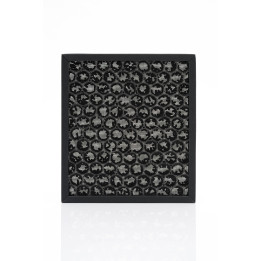
Activated carbon filter for OneLife X, 1 item
€29.00
€23.77 excl. VAT Rated out of 5 stars based on review(s)
 With you for 10 years!
 Choose the right filter according to what you want to remove from the air: particles, dust and pollen are handled by the particle filter unit, while odours and volatile organic compounds require activated carbon. With some devices, the filter does not always need to be replaced; proper cleaning is sufficient.
Filters for air purifiers are not all the same. Some capture particles such as household dust, pollen, mould spores, pet hair and smoke particles. Others are intended for gases and odours, where activated carbon is needed. When buying, it is therefore important first to know whether you are looking for a replacement filter, an additional filter for odours, or just instructions on how to clean the existing filter unit properly.
In this category, we offer filters and maintenance accessories for the air purifiers in our range. In the OneLife X system, the main filter unit is washable, while the activated carbon filter is a consumable part that is replaced approximately every 6 months, depending on the duration of use. This helps you avoid unnecessary replacements while maintaining the proper operation of the device.
Replace the filter when it is designed as a consumable part. This applies mainly to activated carbon filters. Activated carbon works by binding odours and volatile organic compounds to itself, but it gradually becomes saturated with use. Once saturated, washing does not restore it to its original condition.
With OneLife X, the activated carbon filter is the only regular consumable part. The manufacturer states replacement approximately every 6 months, while the actual interval depends on the duration of use and the load in the room.
It makes no sense to replace a filter if it is designed as a washable filter unit. With such solutions, proper cleaning is part of regular maintenance, not a sign that a new filter needs to be bought. This is an important difference compared with devices that use dense consumable filters.
For OneLife X, the manufacturer recommends cleaning the main filter unit approximately every 3 months. The prefilter is cleaned approximately every 6 months, while an independent tester recommends cleaning the prefilter more often if there is more dust or hair in the room.
Activated carbon is intended for substances that a conventional particle filter does not handle as effectively. Particles such as dust, pollen, mould spores and smoke particles are solid or liquid particles in the air. Odours and volatile organic compounds, however, are gases, so they need a different approach.
The manufacturer OneLife explains that the electrostatic collector works on particles, while activated carbon pellets are needed for formaldehyde and similar gases. These act as an additional protective barrier against odours and VOC.
Do I need to replace the main filter unit in OneLife X?
Not as a regular consumable part. The main filter unit in OneLife X is washable. The manufacturer states that, with regular and careful cleaning, it can last for the entire service life of the device. After washing, it must dry for at least 24 hours before you put it back into the air purifier.
How often should I replace the activated carbon filter?
With OneLife X, the activated carbon filter is replaced approximately every 6 months, depending on the duration of use. If the device is often exposed to kitchen odours, cigarette smoke, new furniture, textiles or pets, replacement may be needed sooner.
What is the difference between a particle filter and activated carbon?
A particle filter is intended for airborne particles such as dust, pollen, mould spores, pet hair and smoke particles. Activated carbon is intended for odours and volatile organic compounds, because these substances are gases and a particle filter does not capture them in the same way.