


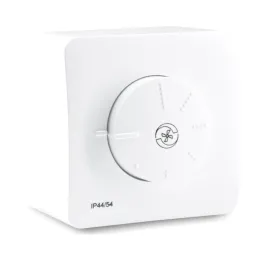
4A Speed Controller for Industrial Fans aRo 400
€128.67
€105.47 excl. VAT Rated out of 5 stars based on review(s)
 With you for 10 years!
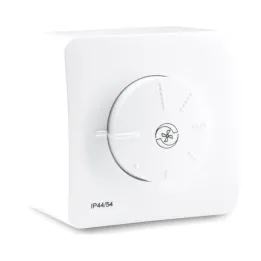
Fan controllers allow the operation of a single-phase fan to be adjusted where the fan manufacturer permits control by changing the voltage. This category includes fan speed controllers with a rotary knob, intended for ventilation fans where you want to manually reduce or increase the operating speed.
This type of fan controller is useful for industrial, roof and duct or inline fans when the airflow needs to be adjusted to the actual requirement of the room or system. A lower fan speed means lower airflow and quieter operation, but the controller must be selected correctly according to the electrical load of the fan or several fans together.
A fan speed controller is intended for manual speed adjustment of a single-phase fan motor with a rotary knob. The controllers’ power supply is 220–240 V, 50 Hz, single-phase, so they are used in systems where the fan is compatible with this type of control. Before purchase, the fan manufacturer’s data must be checked, as not all fans permit control by changing the voltage.
In this design, the fan speed controller changes the voltage received by the fan motor. When you reduce the speed, the fan pushes less air through the duct, grille or opening, so the perceived operating noise is also reduced. This is useful in ventilation systems where maximum airflow is not required all the time, while you still want to keep manual control over fan operation.
The controller has connection terminals L, N, M and L1. Terminal L is intended for the supply phase, N for the neutral conductor, M for the regulated output to the motor, and L1 for the unregulated 230 V output. This layout allows connection of a 230 V fan controller according to the electrical diagram, but the connection must be carried out by a qualified electrician.
The controller contains a 5 × 20 mm fast-acting ceramic fuse. Only such fuses must be used, as an incorrect fuse voids the warranty. For the 1 A controller, fuse F1.25 A is specified, and for the 4 A controller, fuse F5 A is specified. Replace the fuse by removing the knob, nut and cover; the mains power supply must be switched off beforehand.
The choice of speed controller is based on the fan current or on the total current of several connected fans. The controller must be neither too small nor too large: an undersized controller means the permitted load is exceeded, while an oversized controller reduces the control range. The total load should be calculated by an electrician or installer.
The 1 A speed controller is intended for a load from 0.1 to 1.0 A. According to the manufacturer’s instructions, it is intended for wall-mounted and built-in industrial fans with a diameter from 200 to 400 mm. In terms of current, it is also suitable for selected roof fans if their current matches the permitted range of the controller.
The 4 A speed controller is intended for a load from 0.4 to 4.0 A. According to the manufacturer’s instructions, it is intended for wall-mounted and built-in industrial fans with a diameter from 450 to 630 mm. It is used where the fan current or the total current of several fans exceeds the range of the smaller controller.
Several fans can be connected to one speed controller if their total current does not exceed the maximum load of the controller. It is not enough to check only the number of fans; their currents must be added together. If you are not sure which version is suitable, the selection should be made by a professional who knows the electrical data of the fans and how they are connected.
The controllers in this category are intended for single-phase fans that permit control by changing the voltage. Before purchase, always check the technical data of the fan and the manufacturer’s instructions.
On the page of each controller, in the "Product Details" tab, the "Compatible with" row lists the fans from the range with which it can be used.
The controller can be installed as a surface-mounted controller on the wall or as a flush-mounted controller in the wall. The housing measures 82 × 82 mm, and the depth of the surface-mounted housing is 60 mm. With flush installation, the controller is 32 mm in the wall and protrudes 23 mm from the wall. The weight of the controller is 0.36 kg. The protection rating is IP44/IP54, so the conditions in the room and the instructions for safe installation must be considered when choosing the mounting location.
Before connection, the mains power supply must be switched off. The connection should be carried out by a qualified electrician, as incorrect wiring or incorrect controller selection can cause improper operation. Clean the housing with a damp cloth, but do not pour liquid over the controller. The warranty for the controller is 2 years, and the warranty is void if an incorrect fuse is used.
No. The controller is intended for single-phase fans that permit control by changing the voltage. Before purchase, check the fan manufacturer’s data.
The fan current or the total current of several fans must be checked. The 1 A controller covers a load from 0.1 to 1.0 A, while the 4 A controller covers a load from 0.4 to 4.0 A.
The controller must not be selected with too much reserve, as an oversized controller reduces the control range. The selection should be based on the actual fan load.
Yes, if the total current of all connected fans does not exceed the maximum permitted load of the controller. The total load should be calculated by an electrician or installer.
A lower speed means lower airflow and quieter fan operation. The effect depends on the fan, the ventilation system and the permitted voltage control.